









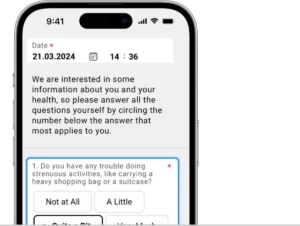





European hospitals are running on hundreds of fragmented applications, yet clinicians still rely on paper, manual re-entry, and workarounds to get through the day. While the ambition for digital transformation is clear, the reality on the ground tells a different story: rising integration costs, 6–24 month IT backlogs, and ungoverned “shadow” tools are limiting what health systems can actually deliver. The gap between strategic intent and operational capability is widening.
This report is based on 50+ structured interviews with healthcare leaders across seven European markets, including CIOs, directors of digital health, clinical informatics specialists, and solution architects from university hospitals, regional health authorities, private hospital groups, and community care providers. All interviews followed a standardised guide to enable consistent comparison. The report captures recurring patterns and structural constraints across application landscapes, integration, governance, procurement, and innovation — offering a peer-validated benchmark for organisations assessing their own digital maturity and platform strategy.
What can you expect?

Fragmentation as the baseline
How hospitals are managing between 10 and 800+ applications daily, and why incremental procurement created the complexity they now struggle to undo.

Paper in the digital age
Where manual workflows, printed forms, and data re-entry persist even in advanced organisations, and the clinical cost of these workarounds.

The backlog trap
Why requests for new clinical applications take 6–24 months, and what this reveals about operating model constraints rather than simple IT capacity.

Citizen developers: risk or accelerator?
How informal builders across clinical teams are solving problems IT cannot reach, and why governing them beats trying to eliminate them.

Procurement realities and entry points
How formal tender thresholds, training budgets, and small-scale pilots shape what is possible for new platforms and vendors.

The platform shift
Why healthcare leaders are moving toward modular, data-first Digital Health Platform (DHP) architectures, and the key criteria to evaluate when choosing one.


Tim Gornik,
Senior Business Analyst, Better
Tim Gornik focuses on healthcare market intelligence, competitive strategy, and go-to-market positioning for digital health platforms. With a computer science degree from Duke and an MBA in Business Analytics, Tim brings experience in strategy consulting and product marketing. His ability to translate complex market dynamics into actionable growth strategies helps healthcare organisations understand the case for open, composable platforms over legacy point solutions.
Join 50+ European healthcare leaders in redefining digital maturity. Download the white paper to help your organisation move from fragmentation to a unified platform strategy.

FAQ
What is the average timeline for implementing new clinical applications?
- Research shows that healthcare departments typically face implementation backlogs of 6 to 24 months from the time of request. This is largely because IT capacity is consumed by the maintenance of existing legacy systems, leaving little room for new departmental needs or innovation.
What are the common procurement thresholds for hospital IT systems?
- European hospitals utilise formal financial thresholds that trigger different procurement requirements. While £30,000–£40,000 is a common lower threshold, figures such as €200,000 and €400,000 represent major system procurements under EU/UK regulations. Organisations often use smaller “innovation budgets” of approximately £5,000 to pilot new tools without a full tender process.
What is a Digital Health Platform (DHP) and its three-layer architecture?
A Digital Health Platform (DHP) is an architectural approach consisting of:
- A Data Layer: Based on open standards, to liberate siloed data.
- A Marketplace Layer: Containing reusable Packaged Business Capabilities (PBCs).
- A Composition Layer: Where clinical teams can build new digital experiences using low-code tools and healthcare templates.
How many software applications does a typical European hospital use?
Most European healthcare organisations operate a large number of digital systems in parallel, ranging from 10 to several hundred. For instance, a German university hospital reported approximately 200 applications, while a Spanish regional health service manages an ecosystem of around 800 applications serving 8 million citizens.
Who are “citizen developers” in a healthcare context?
In healthcare, citizen developers are clinicians, researchers, and data modellers who build their own digital tools—such as REDCap forms or Excel trackers—to solve practical problems. While currently treated as “shadow IT”, these individuals are often motivated by the desire to improve care pathways and resolve local bottlenecks.
How do open standards like openEHR and FHIR prevent vendor lock-in?
Open standards ensure that healthcare data is stored in a vendor-neutral format. This allows organisations to own their own data and innovation capability rather than being dependent on a single vendor’s roadmap. This reduces procurement friction and ensures that clinical models can be shared and reused across different institutions.